I have previously talked about How to Create a Cohesive Color Palette for Your Home, (see that post here). Once you have your color palette, how do you actually apply it to your house? I’m so glad you asked!
First the Basics
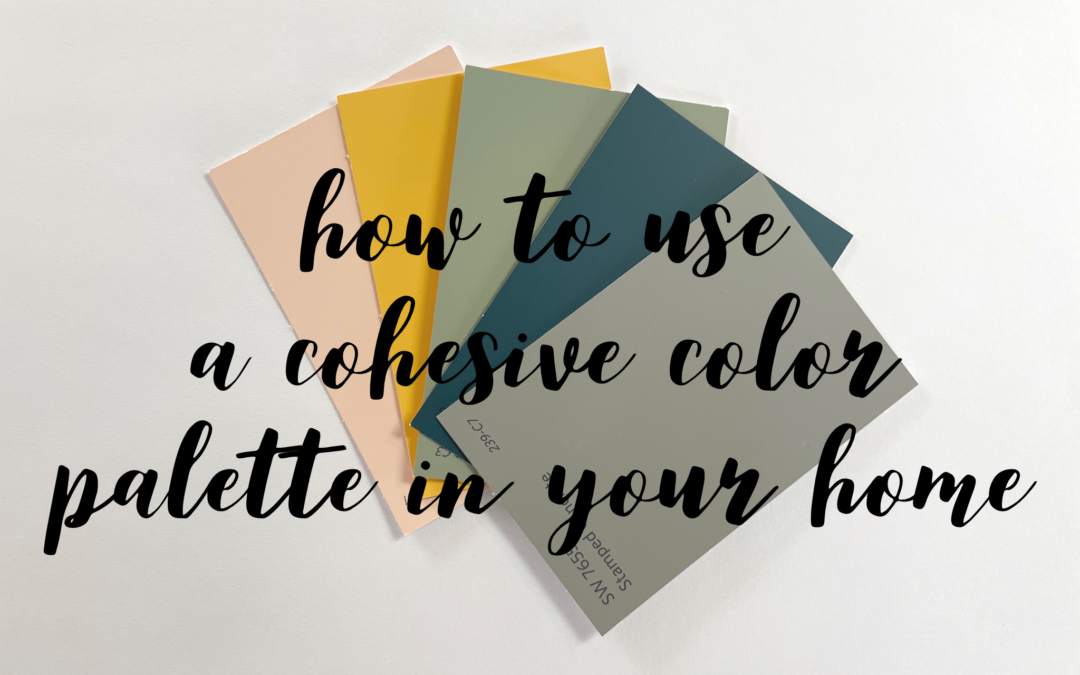
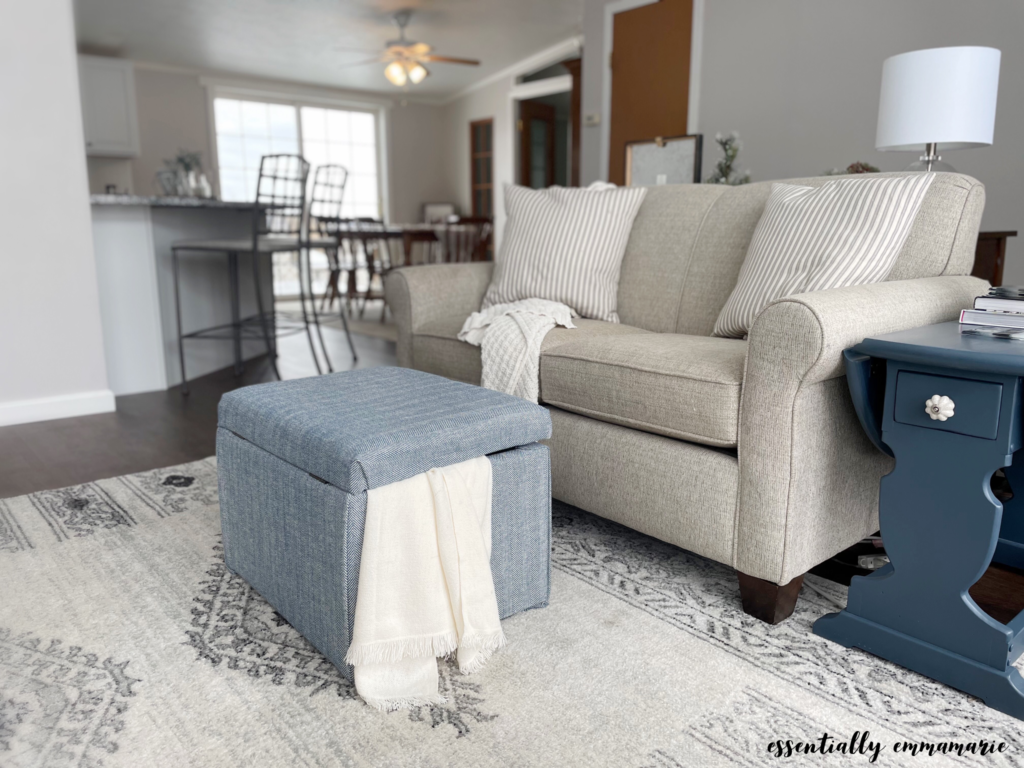
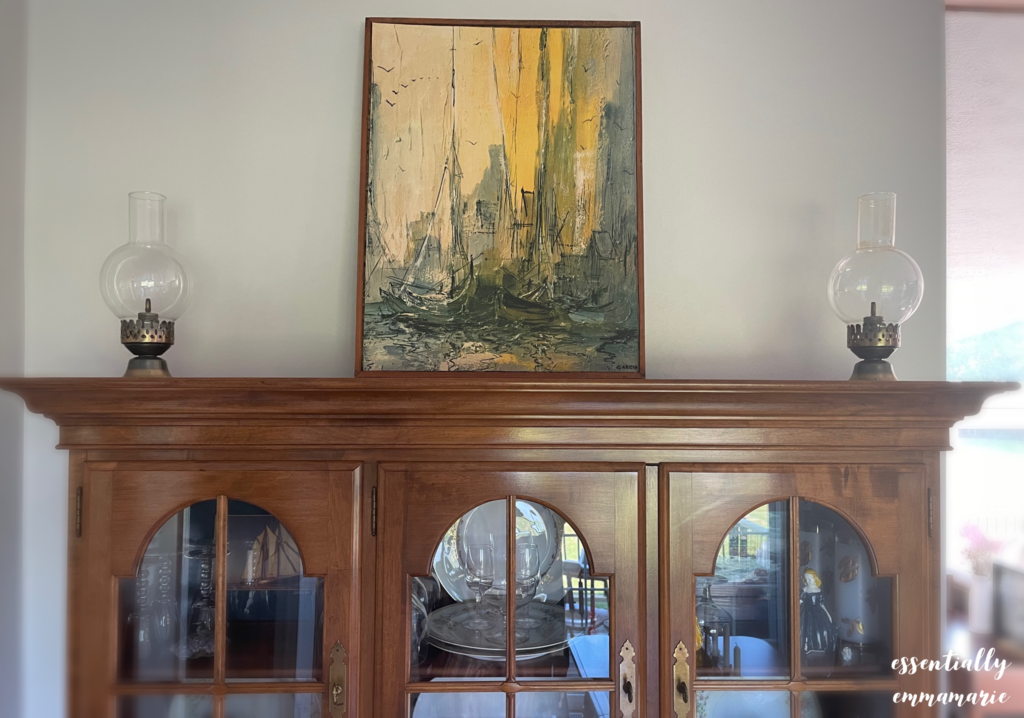
The point of having a color palette is to give your house a cohesive feel. It should not feel like a ball and chain around your neck that you are forever stuck with and can never deviate from, but rather it is a guide to help inform your decorating decisions. You pick three to five colors—the furniture and most of the decor will be chosen from this color palette. For example, my walls are painted a warm tannish-gray color called greige and that is my main color. A lot of my furniture is gray. My accent colors are mustard yellow, faded sage green, and a deep teal tinted navy—like a pair of jeans. I also have white, black, and wood tones in my decor. I consider my main colors in my color palette to be the greige, teal/navy, sage green, and mustard yellow. The white, black, and wood tones I don’t really classify as true colors in my house because I use them as neutrals. If I was going for a super-tight color palette or a monochromatic color pallet then I would count them and limit my color palette accordingly.
Using a Cohesive Color Palette in Your Home
Now that you have an idea of what comprises a cohesive color palette, how do you make it work for you? Do you have to use the same amount of each in your room? Can you ever bring in any little bit of other colors? The short answer is yes to both, but let’s go for the long answer too!
Just because you have a color palette doesn’t mean you cannot vary how much of each color you use from room-to-room. For example, greige is my main color; blue is approximately 60% of my accent color, the green about 30%, and the yellow about 10%. However, this can vary from room to room.
We have one small living area, and then a second slightly larger living room. The second and larger room I have painted the walls sage green. Some say you should never paint walls green and I rebuke this! I love green and I use it!! Since I am using green to such a large degree in that room I have no other green accents in that room (unless you want to count plants). Instead, I lean on my blue for most of my accents and a tiny bit of the yellow—keeping both these color accents pretty light. My furniture in this room is all neutral colors. However, by adding touches of blue and yellow to this room, it keeps color bouncing around the house and feeling cohesive.
What About Introducing Other Colors to Your House?
What about adding small touches of color, outside of your color palette to your home? I say you can do it but keep a few things in mind:
(1) The more colors you add to your home the trickier it is to style it well.
(2) The more color that is not repeated throughout your house, the more disjointed your home will feel.
I do allow a few touches of oranges and purple in very small doses in my kitchen. I have a trivet made from dried botanicals that is very pretty so I display it all the time in a corner of my kitchen. I also use it all the time so it is nice to have it within an easy reach!
Can You Use Different Shade of Colors from Your Color Palette in Your Home?
By doing this, you will end up weakening the integrity of your color palette. Remember the color palette is a guide, but it is also a tool. Having this framework is what allows you to be able to move items from room-to-room interchangeably. It is also what creates flow in your house. I think it is best for the sake of cohesiveness to keep the same color flowing in all the main areas of your house. If you want to branch out into different colors, the bedrooms and bathrooms are the best places to do this.
If you are craving a color that you use nowhere else in your house, a bedroom is a great way to satisfy that craving. However, if you are using, for example, a lighter or darker shade of a color that you are already using somewhere else in your house, then a lot of your other colors will still play nicely with this color, enabling you to play musical chairs with your other decor pieces!
I hope this helps to give you more ideas for how you can use a cohesive color palette in your home to make your decorating easier and more fun. As always, if you are enjoying these posts please share them with a friend—it helps me so much! Until next time—happy decorating!
Hey! May I Send You Something?
If you are here, chances are you just might like my writing. (wink) If you Drop your email address in the box below I’ll save you time by emailing you the link every time a new post comes out!
And I will put my Spirit in you and move you to follow my decrees and be careful to keep my laws.
Ezekiel 36:27 NIV
I grew up attending that kind of little church in the middle of nowhere. You know the one . . . it’s the type of church that is in every book about a small town which no one really thinks exists. It was a great church but the congregation was very, very small! So small in fact that we would have one service in the morning and would combine with a sister church for a second service in the evening.
The church we went to in the evening was still small by most standards but seemed considerably larger to me than our “morning church”. I think this church would be a bit of a culture shock for anyone used to today’s contemporary services without hymnals, and where the services clipps along at a predetermined pace. Not at this church. We would grab hymnals and sing, not to a fancy worship band but to the sound of the piano, a guitar or two, a violin, a couple of mandolins, and perhaps a flute—whatever instrument anyone could play would sound forth from the front pews of the church!
After singing there was prayer—and this is not the staid prayer of many churches. No, this was a vast chorus of many different voices praying out loud until the prayer leader said amen. Sometimes there was no time for preaching as people would be at the altar praying as burdens were heavy. (This is when the service timeline might go off the rails.) Oftentimes we would be invited to testify—to share what God was doing in their lives. People would testify how money for a bill had miraculously appeared; about a medical threat could no longer be found; how this prayer or that prayer had been answered. One person would finish and another would pop up—not every week—some weeks were quiet with one or two people sharing and other weeks the preaching part of the service would be skipped entirely as everyone had so much praise to offer! You simply cannot cut people off who are praising God and sharing what He is doing in their life! On those occasions our Pastor would say he simply could not top that! I don’t know why churches don’t do this today.
There were some saintly elderly people in the congregation and they are the ones I remember and miss the most. We might be in the testifying part of the service, if they felt the guidance of the Holy Spirit, they didn’t hold back! They would stand and shout, “Glory to God!” One of the older gentlemen would run a lap or two around the church shouting, “Praise and Glory to God, well I say Hallelujah!” These people were filled with the Holy Spirit!
I know these things might sound a little odd when compared to most church services these days—and if you don’t currently attend church and this sounds a little fanatical, please don’t let this dissuade you—most churches are not like this. I share this to say let us not become so attached to our schedules and what is expected that we don’t leave room for the Holy Spirit to work.
This is not just for church and the church services. What other times in your life does the Holy Spirit prompt you to do something? Do you need to share a hard time that you went through with another Christian to encourage them? Do you need to step out and invite someone to church for the first time? These things can be scary and uncomfortable but sharing the faith is what Christian life is all about. It doesn’t have to be something big, but the next time you feel an overwhelming impulse to share something with someone and you don’t feel like the thought came from you—do it! You never know how it could change someone’s life and impact them for years to come!
P.S. Don’t forget to search @EssentiallyEmmaMarie on Instagram and follow along with me there too!
Hey! May I Send You Something?
If you are here, chances are you just might like my writing. (wink) If you Drop your email address in the box below I’ll save you time by emailing you the link every time a new post comes out!
I must think habits are the secret to everything we want to be and do! I have read my fair share of books about habits and I find everything about habits fascinating. I love reading about how habits are formed, how to break bad habits, how to develop new habits and how good habits can simplify my life!
Below are few of the books that I have read about habits.
The Power of Habit by Charles Duhigg
This book was very informative regarding—you guessed it—the power of habit! This book is not about what habits can do for you and your life but rather about what habits have done for others. Duhigg talks about how habits have helped some individual surpass seemingly impossible odds and, conversely, he talks about how habits have destroyed the lives of others. There is also a lot of discussion about how habits are made and what goes on inside our brains. Duhigg also discusses how habits can be used corporately to turn around entire institutions. If you are looking for a book that is a breakdown of habits, and how habits can change your life, this is a great book. However, if you are looking for help to develop and implement habit into your life then this book will not do a lot for you.
My takeaway: Habit is a large part of our lives whether we realize it or not. Habits can make or break individuals and companies.
Better than Before by Gretchen Rubin
Ms. Rubin breaks down four tendencies that are habit-related: why habit matters, how habits are formed, and how to most easily and effectively implement new habits into your life. She especially focuses in this book on how habit can give us freedom in our lives rather than restricting us. Habits are what we do without thinking about it. Habit takes away the need to make decisions and frees up mental space to allow for us to concentrate our efforts on what matters most to us. If you have had trouble developing new habits in the past give this book a try!
My takeaway: I really enjoyed how Reuben takes a look at habit through the framework of the four tendencies, and how our innate tendencies can inform how we approach forming habits. (To read about the four tendencies check out that post here)
Atomic Habits by James Clear
This book examines the effect that small minute changes can have over a lifetime. Seemingly small inconsequential changes can add up and make a big difference over a lifetime. This book reminds me a lot of The Compound Effect as both stress the cup active effects of habit over a lifetime. Clear offers tips on how to develop and implement habits into your life, one little change at a time. He gives tips such as habit stacking, stacking a new habit onto an old habit, and the two-minute time cap—after two minutes of doing the new thing, you are done. This is how you can break down the obstacle of starting.
My takeaway: This book is full of tactical tools to help put new habits into place.
The Compound Effect by Darren Hardy
While not exclusively about habit, this book is great because it stresses the fact that it is not the big things in life that make the biggest change in our lives but rather it is the small things. The little minute changes that you make day after day compound and make a big difference over a year or more. A lot of books on creating new habits can be overwhelming, but since this book stresses the importance of small wins, you can come away feeling encouraged by a small change that you made! (I also talk about The Compound Effect in my post, Books to help you build the life you want in 2021 click here to read about those books.)
My takeaway: This book reminds you of what a difference a minute change can make over a year, or lifetime!
Hey! May I Send You Something?
If you are here, chances are you just might like my writing. (wink) If you Drop your email address in the box below I’ll save you time by emailing you the link every time a new post comes out!
For if you forgive other people when they sin against you, our Heavenly Father will also forgive you.
Matthew 6:14 NIV
A couple years ago I had this . . . situation. There was this individual, let’s just call this individual Sue, who I initially liked. Situations aligned and Sue was able to help me out with a project and in return I was able to teach her a new skill. It seemed like a godsend situation—until it didn’t. I saw a whole different side to Sue than I had previously seen, and I didn’t like it. I tried being patient. I had given her second chance after second chance. I tried to be loving yet firm. It didn’t matter, Sue’s actions didn’t change.
Eventually things got unbearable and we decided to go our separate ways—no hurt feelings. Except that mine were hurt. By all accounts, Sue had not treated me right: she knew it and I knew it. This was one of those times in life when we are wronged and have done nothing to deserve it. I told myself, my husband, and my mom that I had simply seen a different side to Sue’s personality and had no desire to continue the friendship we previously shared. And, no, I wasn’t bitter and, yes, I forgave her for the way she wronged me. But my actions spoke otherwise.
As I said, we went our separate ways but when I would see Sue, I staved off conversations with a quick wave and smile before turning and making a graceful exit. When it looked like she was going to come over and join a conversation, I would step closer to whoever I was talking to, making it look like we were in an engrossing conversation and we shouldn’t be bothered. It worked. I successfully avoided Sue in a friendly manner for months and had myself convinced that I was okay. I ignored the flood of angry emotions that boiled to the surface when she came to mind.
Ignoring or barely tolerating a person is not forgiveness. Forgiveness is being able to truly love that person again.
A few months later I was sitting in church, I don’t remember what the sermon was on, but a still small voice said in my ear, “What if you are the only Jesus they ever see?” I knew who the “they” was. Sue had been going through a long rough patch. Life hadn’t been easy for her, and I knew she had been struggling for a while. She kept waiting for the one thing that would change everything for her. Funny isn’t it? We wait for the “one thing” to happen that will change everything and we forget that it is the Creator Of All Things who is the only one who can change anything. What if I was the only example of Jesus that Sue had in her life at this time? Would I let my bitterness get in the way?
I believe the Holy Spirit was prompting me but I told myself I had just imagined it. (Never mind the fact that there was no way I would have come up with that thought regarding Sue on my own!) So now I was stuck. I was supposed to take action. I was supposed to reach out to her. I thought it would be weird to call or to text her out of the blue. It would be even weirder, not to mention awkward, to invite her over for dinner. (Oh the lies we tell ourselves!) Then I looked out my window and saw my blueberry bushes—they were brimming with big, juicy berries that desperately needed picking—and I got an idea! Blueberries are Sue’s absolute favorite food so I asked her if she wanted to come pick blueberries with me. She said yes. We moved on. I forgave.
Not too long after that she moved away. If I had ignored the Holy Spirit’s prompting or procrastinated for much longer, I would have deprived myself from being able to forgive Sue. Forgiving her wasn’t just about her. It had been about me too. I’m not sure she even realized the depth to which I felt she had hurt and wronged me. But I knew. And it had been festering. Typically, I am not slow to forgive—I have a short memory and often times can’t even remember why I was hurt or angry! This time though, it was a struggle. If I was or ever will be the only example of Jesus that someone sees, I sure do not want them thinking that Jesus is a bitter God who is slow to forgive. I want them to see the Jesus that I willingly serve, who is slow to anger and abounding in mercy, especially to me.
If you are enjoying these posts I would greatly appreciate it if you take a moment and share them with someone who you think might enjoy them too! It means so much to me when you do this!
We all reach that point when we get, well . . . bored with our homes. The major holidays that we decorate for are behind us, and our home is furnished: we have rugs, lamps, and essential things, but then our home just starts to feel static, a little dull and boring. This is when I always want some retail therapy!
A while ago I learned a kind of quirky trick that works when I’m in a shopping mood, but don’t need to go shopping because I don’t need anything. I go grocery shopping. It’s weird, I know, but I get the endomorphic boost of buying things—in this case groceries which are necessary—and since I have a low tolerance for how long I can shop this usually does the trick for a while. What does this have to do with anything? I think the same general concept can be applied when it comes to being bored with our home.
Step One: Declutter
When I start to get bored with my home something else happen simultaneously—my home gets a little messy. I’m pretty OCD so it’s not like my house ever gets terribly messy, but it will lose some of its polish. This is somewhat of the “which came first, the chicken or the egg” conundrum because I’m not entirely sure if my house gets messy because I get bored, or if I get bored then it is easy for me to let it get a little sloppy. Regardless, the same cure will work—purge!
If you are feeling bored, before you go out and purchase more things, start with decluttering your space. It does not have to be a huge overhaul but look around for any “hot spots;” places where mail and magazines are gathering, drawers that are overcrowded, and even what is going on underneath the sink! Doing a little purge will give you the same endomorphic release that shopping does and if you still do decide to go out to buy some new things, you’ll have a little more room for them!
Step Two: Shop Your Home
While you are decluttering keep your eye open for anything you may have forgotten about. Are there dishes that you love that are behind a closed cabinet door? Pull them out! Can you use them as a tray? Can you tilt a tray that you love up on its side and use it on your mantle? Is there a cup or bowl that you could stick a little succulent in and place on your coffee table books? Try looking at things with fresh eyes and see what you may be forgetting about that you already own and love.
Step Three: Play Musical Chairs
Try moving one item in each room to a different room and see what happens. So often we purchase something for a room; over time we add other elements to that room and slowly we start to not love that lamp that was in the living room as much as we first did. Meanwhile, we desperately need a lamp for the guest room! This is another area where we become blind to the options before us as we are so used to how things are that we forget we can move them.
Step Four: Rearrange Your Furniture
My mom is adamantly opposed to buying furniture for her house that will only allow one option for furniture arrangement. She wants to have options! She wants to be able to move the table, chairs and couch and swap things all around. (Her house is open concept so that does make this easier.) Moving furniture around will help to inspire you and get your creativity flowing!
Lastly: Count Your Blessings
Because of technology, we have so many opportunities to see inside other’s homes and it sparks a desire within us to want them too. Marketing messages are aimed at making us less content with what we already own. We see the influencer on Instagram and all the cute home items in Target and we start to feel like our home is sub-par. But look around! Look at what makes your home feel like you. You bought these things (hopefully) because you love them, so embrace your home and the items within it! Maybe you need to do a little shopping refresher—that’s ok! Just don’t lose your home’s soul to the latest trend if it’s not you. Make your home a reflection of you—of the things that you enjoy in life. And most importantly, don’t be afraid to live in your home!