But lay up for yourselves treasures in heaven, where neither moth nor rust destroys and where thieves do not break in and steal. For where your treasure is, there your heart will be also.
Matthew 6:20-21 NIV
I was given a box of letters and other miscellaneous items from my grandparents’ childhood and their young adult lives. There were letters that grandpa wrote to grandma while they were dating and letters from grandma’s family to her at school. As I was sorting through these letters, I came across one in particular that I stopped to read. There were two sheets of paper and each paragraph was written by a different member of her family telling the current news about themselves. Her sister wrote of the cut on her hand which was why her writing was particularly messy; her other sister wrote about how it was too icy to go into town so they had been cooped up inside, and her father wrote that he was milking Old Bessie and that he missed my her [my grandma’s] help! These were words on a page but they weren’t just words contained in these letters. These letters held collected moments—remembered days—snapshots of days from a bygone era—they were stories of lives lived.
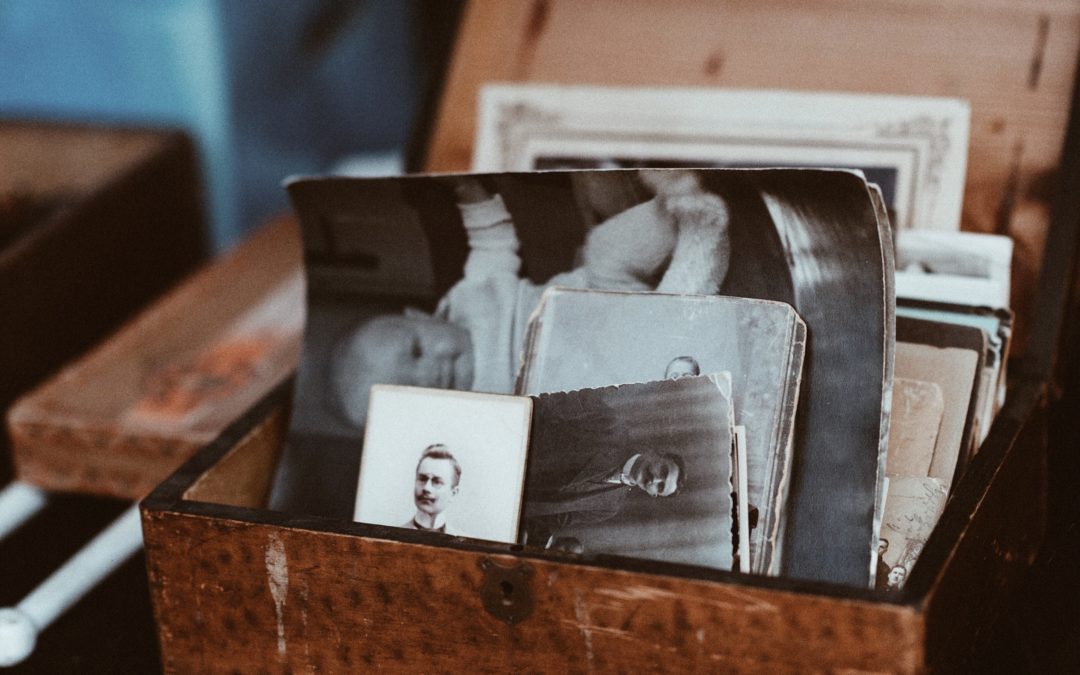
In with all these letters were also old photographs: family portraits, snapshots, and school photos. I saw my grandfather grow from a boy, to a young man, to an adult, to the grandfatherly, old man I knew and loved so dearly. I have pictures of him as a farm boy with his best cow in the 1940s, as a young business man standing next to my grandmother, and pictures of him holding us grandkids. All of these things are the paraphernalia of a life gone by—a letter, a photo, a random token from a vacation. These everyday things are the artifacts left in one’s wake.
And yet they are not all the things, they are the physical reminders of a life on earth, but there are the nontangible and much more valuable remnants too. The memories of my grandfather teaching me to ride a bike, grandma teaching me her cooking skills, and memories of her hospitable nature to anyone who crossed her doorstep. There are the memories of weekly trips to the library, how they were always encouraging me to read, setting an example in front of me. These are the things I remember. All of these things and so much more are the legacy of my grandparents to me.
We will all leave behind a legacy when we are gone. Jesus did. He implored His disciples to spread the gospel to the ends of the earth. He left an unparalleled legacy of loving others. Even nonbelievers agree with this. Our possessions will remain on this earth, our souls will leave our bodies, and yet a legacy will remain. Jesus told the young lawyer to sell all he had to the poor, because his legacy was not in his possessions but in his heart. What is in our hearts? It is easy to shake our heads at the young lawyer who went away sad because he was very wealthy, but do we acknowledge our own follies and foolishness? We place so much value in things—it’s hard not to. But what of the value of memories we leave with the ones we love? What will they remember about us?
What about the intangible in our lives? The people in our lives, are we loving them well? The spiritual gifts we’ve been given, are we utilizing them well? We will leave behind remnants of these gifts as well, not tangible as an old letter or photograph, but a snapshot nonetheless of our life. The base truth is that we do need things in this life. Money is useful, a house keeps us comfortable and insulated from the elements, but these too are just things. We can look at another biblical figure, Simon Peter who, though he had many foibles, ultimately got it right, dedicating his life to following Christ.
We will leave others behind and they will remember who we were. What we did for a living won’t necessarily be remembered as much. Some of these people will be responsible for going through the memorabilia of our lives. Some will go through the stacks of memories we have left imprinted on their minds. Will they shake their heads at us like we do the young lawyer in the Bible or will they remember us like Simon Peter whose antics we laugh at but ultimately admire because he got it right. Are we getting it right?
Disclosure
Please remember that this post contains affiliate links; that means if you click on the link, I will make a small commission at no extra cost to you. It’s a way to support my blog! I will only ever share an affiliate link if I love the product and think that you just might love it too!
It is October here in Pennsylvania—one of the most beautiful times of the year. The leaves reach their peak color turning hues of bright red, vibrant orange, and golden yellow. The days are mild, blending into crisp evenings. The natural world sheds its elaborate outer skin bearing the bones beneath; the tree branches and the spent stalks of flowers will soon glisten in their frost-coated glory.
I am always hit with a touch of nostalgia at this time of year, an almost melancholic air settles over me but not in a bad way. I want to drink in every golden drop of sunshine and store it away within me for the gray days that lie ahead. I want to walk through corn mazes and remember past harvests when life would then slow down. This is a time of year that makes me want to slow down and cocoon myself indoors—curled up before a crackling fire with a delectable cup of tea or hot chocolate and lose myself in a captivating read. I want to light candles, pull out throws and blankets, and maybe even play a game of backgammon on the living room floor. These things make me feel more warm and cozy rather than sad and empty. It is an awareness that time is passing, and will continue to pass, but for a short while it seems to slow slightly, allowing us to take a moment to breathe it in—if we are watching for it.
What a wonderful time of year to observe the slowing of the natural world. How much more wonderful when we allow ourselves to bask in the slowness of the season. It is restorative to slow down with the season and reemerge rested and ready to embrace a new season. It wasn’t so long ago that we worked furiously in spring and summer; we would started to unwind after a busy harvest season, and then be stilled in winter. How did it happen that every season became as busy as the one before it and the one after? We were made to have busy seasons bursting with life and activity and to have slow seasons; but, when did we decide that we could thrive without pausing to notice that change is happening, that we don’t need to unwind, that we don’t need to rest? What do we gain, truly, by pushing and forcing every season to be the same? Perhaps a better question is how much do we miss by pushing through the seasons of our lives, acting as if each season is uniform.
We rush and we hustle, forgetting that rest is not superfluous. We need time to feel the seasons, both in the natural world and in our personal worlds as well. We need space and time to process life, to relax, to reflect, and to be filled and inspired for the next season. We need time to feel the weight of the seasons, to evaluate whether this is really the life we want to live and are meant to be living. For what is our life worth if we get to the end only to realize that this is not the life we wanted to live and realize that we have used our time unwisely, without taking the time to slow down and consider the seasons of life—and now there is no time to change course.
This autumn, whatever autumn may look like for you, I encourage you to slow down, rest up, and absorb all the delightful scents and occasions this season has to offer. Let’s slow down and take advantage of opportunities in which precious memories can be created with the special people in our lives so that when we get to the end we will be able to reminisce and take comfort in those memories. May we remember that the seasons will come and go, the world will keep turning, but there is no promise that we will be here to enjoy it “next year,” so let’s focus on enjoying today.
Moses’ father-in-law replied, “What you are doing is not good. You and these people who come to you will only wear yourselves out. The work is too heavy for you; you cannot handle it alone.”
Exodus 18:17-18 NIV
I know a couple who both just retired. They are still young, especially to be retired, and they still have lots of life left in them. The question is—what to do with it? What do you do when you have always been known by your career—by what you do? What is left when all is stripped away?
It is so easy to find our worth in our career, by what we do, even if we are someone who doesn’t work outside the home. We try to find our value in external things; the volunteer position, the type of the home we keep, the number of homemade meals we prepare. Usually it goes far beyond this. In today’s day and age, we often are busy working our day jobs, running around to different activities, rushing home to prepare an all-organic, gluten-free, dairy-free, superfoods-type meal, and then we hurry to clean everything up in order to do more work—be it a side hustle or a house project, and then we fall, exhausted, into bed. This is not how we were meant to live. We end up doing too much in some sort of contest to prove our self-worth.
This happened in the Bible with Moses too. Talk about having everything stripped away! He went from rags to riches, back to rags, and to riches again! Moses was born into an enslaved Israelite family, who, in an effort to save his life, was sent floating in a basket down the Nile River. Being found by the pharaoh’s daughter, he is raised in the pharaoh’s court as a prince. When he was grown, Moses killed an Egyptian when he saw the Egyptian beating a fellow Israelite. He then fled into the desert, where he became a shepherd with a nomadic people. Doesn’t that sound like the storyline of so many movies—the broke young person who works their way to the top, becomes a powerful executive, and then throws it all away to go live a simple life? But then things change for Moses.
While Moses was shepherding his flock he came across a bush that was burning but it was not consumed. God speaks to Moses through the bush and tells him to deliver His chosen people, the Israelites. Moses doesn’t want to go but finally he listens and goes to Egypt. A lot happens there; eventually Moses makes it back out of Egypt with all the Israelites. He is a leader, the judge of all disputes, the spiritual leader, and basically all things to all people. He is talking of this to his father-in-law, Jethro, when Jethro stops Moses and tells him that he is doing too much. Jethro tells Moses he needs to delegate. Moses listens to Jethro’s advice and sets up a judicial system.
I think maybe Moses got carried away doing too much in effort to make up for his past wrongs, both perceived and legitimate. He killed an Egyptian—strike one. Then he fled to the wilderness abandoning his people—strike two. Maybe another reason he didn’t want to go back to Egypt is because he didn’t want to hear the Israelites accuse him of not caring about them. After all, he did leave! He escaped Egypt like so many of them wanted to do but couldn’t. Maybe Moses was eager to prove himself so he took on all the responsibilities that he could to try to make up for it.
But Moses had someone to call him out. He had someone to remind him that godliness isn’t busyness. And what’s more . . . Moses listened. He accepted the counsel of a trusted friend and mentor. He took a step back to look at what God had really called him to do and let the rest go. Moses seemed to know that when all is stripped away, it wouldn’t matter because he found his worth in God.
Do we find our worth the same way? If confronted as Jethro did to Moses, would we be humble enough to realize that very few roles are ones that only we can fill? Would we have the wisdom to relinquish control and get back into the sphere to which God has called us? When all is stripped away, would we be happy with what remains?
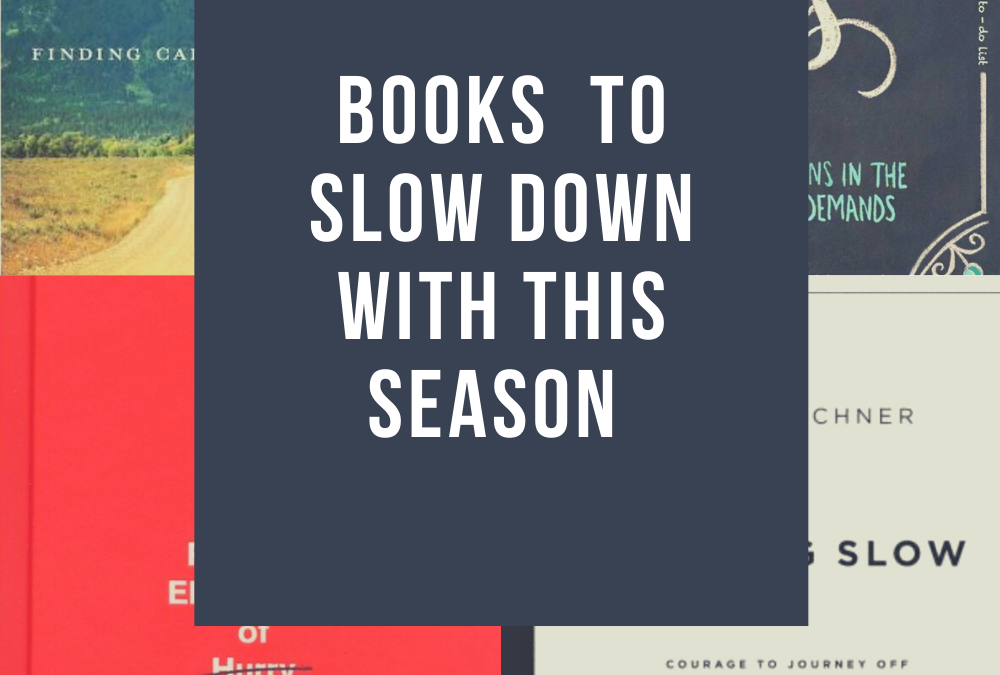
I always feel that we can learn something just by watching the natural world. Just as the natural world retires and withdraws for a season, so too can we benefit—from not just a day of rest, or a week of vacation, but rather an extended period of time, a season if you will, of focusing on rest and not a whole lot else. We all need a season every so often (perhaps once a year?) when we aren’t focusing on the running around, on all our projects, and the go, go, go of it all. We would benefit greatly if we would just quiet down and be still long enough to listen to that still, small voice inside of us, and reflect on the life we are living. Is this really our best life? Is this really the life we were designed to live? Here are several books to slow down with this season.
Disclosure
Please remember that this post contains affiliate links; that means if you click on the link, I will make a small commission at no extra cost to you. It’s a way to support my blog! I will only ever share an affiliate link if I love the product and think that you just might love it too!
The Best Yes by Lysa TerKeurst
The focus of this book is making sure that all the yeses that you’ve been saying are really the ones that you want to be saying. When we say yes to all things, we miss out on saying our best yes—the one God created us for. Helping others in meaningful ways, growing our intimate relationships—these are things we miss out on when we are busy saying yes to every single thing that comes our way. What I really appreciated about this book, was Lysa’s Bible-based framework for deciphering what we should say yes to. In an age where so many messages are yelling the self-care message, it is easy for self-care and creating time for yourself to be an excuse to be selfish with our time. I appreciated the biblical approach, backed by scripture verses, to help inform our decisions and make sure we are always saying our best yes.
Chasing Slow by Erin Loechner
In this book Erin tells her story. Starting from the beginning, she tells of when she and her new husband moved to California to start their careers, how busy their life became, and then just as they were starting to focus on slowing down, the economy tanked, sending them packing and moving in with their parents. She talks of how she started her blog Design for Mankind, and the ongoing battle with chasing slow, leaving the frenetic pace of life as behind them as possible. One of the recurring topics of the books is that Erin’s husband has a brain tumor. It is inoperable and while it hasn’t shown signs of growth as of the writing of her book, it very well could. The doctors originally told him he wouldn’t live as long as he has. The overtone of this medical condition gives weight to this book. If we only had ten years left to live, where would we be allocating most of our time?
The Ruthless Elimination of Hurry
My favorite quote of the book . . . “Jesus never hurried.” Enough said? Honestly, I don’t even remember a whole lot of other takeaways from the book besides the discussion on the fact that Jesus never hurried—anytime or anywhere. When we break it down and think of hurrying and how it portrays us to others, it is the exact opposite of how Christ wants us to act towards others. In my own life I think about how many times I’ve hurt people’s feelings or had spats with people—I’d say 95% of the time the discord brought about in my relationships with others is brought about by one of us hurrying—and usually it’s me. If you rush about a little more than you should (what is an appropriate amount to rush?), give this book a try.
Anxious for Nothing by Max Lucado
This is a short little read and while not specifically about slowing down, this book is a biblical approach to letting go of anxiety and worry. When we are filled with anxiety and worry it is difficult for us to slow down and rest. Mr. Lucado takes a scripture-based approach on how to invite God into our lives and help us let go of our anxieties.
Rest
I talked in depth about this book in my post “My Impression of Rest: A Book About Work” and again, this book isn’t specifically about slowing down—it is more about the part rest can play in our lives. I’m still getting over how short, but really focused, the work days were of some of the most influential people throughout history—we are talking about people like Edison! Long doesn’t necessarily mean a lot of meaningful work. There is a point of diminishing returns, and I believe that is something that often gets overlooked in our culture today.
I’ve enjoyed these books to slow down with this season and I think you may enjoy them also. Thank you!
Hey! May I Send You Something?
If you are here, chances are you just might like my writing. (wink) If you Drop your email address in the box below I’ll save you time by emailing you the link every time a new post comes out!
A while ago my husband and I went to Mexico for the first time. ( see my posts: Limited by Fear and The Fear That Holds You Back, I promise I will be through writing about this experience soon—maybe.) I was excited but also nervous as we prepared for this trip. I only had traveled internationally once before and had only been on a plane on two separate occasions in my adult life. When I was little I had flown quite a bit and, while I wasn’t afraid to fly, I was very apprehensive about all the other things, such as getting to my flight, making our connecting flight, going through customs, and finding the shuttle that was to take us to our hotel, and, hopefully, not getting kidnapped along the way—I would fit into a suitcase quite nicely!
While I was very nervous about all these things, I had one reason to not be afraid—my husband! He had flown a lot, and had even taken one more international trip than I had. He was old enough to remember how it was done! He would take care of me! So I told myself to relax and just let my husband take charge.
That Saturday morning we loaded up the car and headed to the airport. We were drinking coffee (we didn’t need), playing beachy sounding music, and getting even more wound up than we already were when suddenly my husband turned down the music and looked at me. “I have to tell you something,” he said. “I’m a little nervous about flying down to Mexico. Even though I’ve flown a decent amount, it’s always been in a group so I never needed to pay close attention. I just had to listen to whatever the group leaders told me to do. But we’ll be okay, right? You’re good with this stuff?”
It was one of the few times in my life that I was struck momentarily speechless. I didn’t know whether to laugh or cry! He had been placing his faith in me and I had been placing my faith in him! Neither of us had a clue that we were each other’s back-up plan. I barked out a laugh and told him that I had been counting on him this whole time! So much for the plan I had constructed in my mind about how I was safe and my husband had it all under control. My plan was worthless. Incidentally, so was my husband’s plan.
How often do we do things like this? How often do we place our trust in ourselves, or in others, or in our circumstances, rather than the One who created it all? Just as I had a false sense of security in my husband’s travel knowledge, so do we have a false sense of security in anything we place our trust in other than God. Circumstances can, and often do change on a dime. Financial hardships arise. Health concerns spring up from nowhere. A loved one is taken away unexpectedly. The life we thought we built vanishes due to some unforeseen circumstance. Life happens and reality hits us. We have virtually no control over any of it, even when we think we do. Control is the word we use instead of faith.
We can feel one of two ways when we are confronted with this reality. One, we can feel terrified of every situation and live our lives in a constant state of fear and anxiety because nothing we do will ever be enough to insulate us from our worst fears. Or, we can feel comforted because no matter what happens, it was never really in our hands to begin with. Rather every situation, every circumstance, is under God’s auspices and everything that happens in this world is filtered through His hands first. This doesn’t mean that He causes bad things to happen, but rather He will sometimes allow bad things to happen because He knows what the ultimate plan is.
We made it to Mexico and back safe and sound. We didn’t get kidnapped, detained, or put in a Mexican jail. While neither of us were travel experts, we had done our research and prepared as much as we could, and oftentimes that is all we can do. We have to do our due diligence and let God handle the rest. Actually, all the time, all we can do is our due diligence and let God handle the rest. Shall we?
P.S. If you have a moment, please share one of my posts that you have enjoyed with someone you know. This helps me out so much and knowing you were thinking of them will brighten the day of whoever you decided to send it to!
Quick reminder that this post contains affiliate links; that means if you click on the link I will make a small commission at no extra cost to you- it’s a way to support my blog! I will only ever share an affiliate link if I love the product and think that you just might love it too!